
Welcome to the Bivalves subsite on Invertebrate Paleontology!
Please enter a genera name to retrieve more information.
Anthraconaia
Classification
Phylum:
Mollusca
Class:
Bivalvia
Subclass:
Pteriomorphia
Order:
Pterioida
Suborder:
Pteriina
Superfamily:
Ambonychiacea
Family:
Myalinidae
Subfamily:
Non-marine and brackish types
Formal Genus Name and Reference:
Anthraconaia Trueman & WEIR, 1946
Type Species:
Anthracomya adamsii SALTER, 1861, OD
Images
(Click to enlarge in a new window)
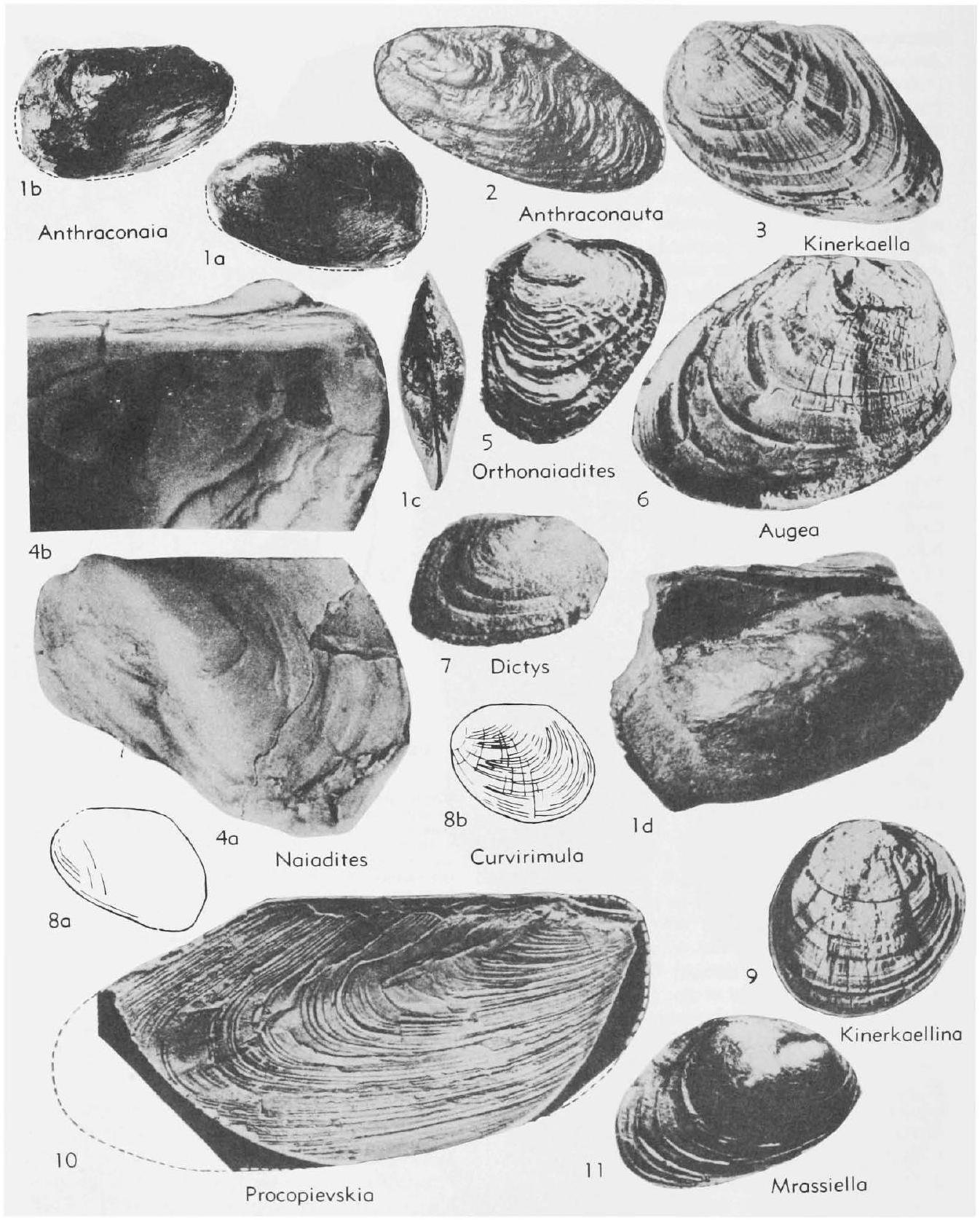 Fig. C31,1a. *A. adamsii (Salter), U.Carb.(U.Amman.), Eng., la-c, ?lectotype, LV ext., RV ext., both valves dorsal, X0.7 (964b), Fig. C31,1d. A. sp. cf. A. fisheri (Wright), U.Carb.(L.Amman.), Eng., hinge and ligament grooves, X2 (WE1r, n )
Synonyms
Anthracomya, Saltermya
Geographic Distribution
W.Eu.-USSR(Donetz)-N.Am.(E.Can.)
Age Range
Beginning Stage in Treatise Usage:
U. Carb.(Westphal.)
Beginning International Stage:
Bashkirian
Fraction Up In Beginning Stage:
48.4
Beginning Date:
319.4
Ending Stage in Treatise Usage:
U. Carb.(Stephan.)
Ending International Stage:
Moscovian
Fraction Up In Ending Stage:
100
Ending Date:
307.02
Description
Obliquely subovate, submodioliform or elongatetrapeziform, integripalliate, inequilateral, equivalved (or slightly inequivalved), with straight hinge line, anterior end narrow in subovate and submodioliform species, posterior end expanded, rounded, or truncated (vertically or obliquely), dorsal and ventral margins subparallel in elongate forms, obtuse carinal swelling in some shells runs obliquely from umbo toward posteroventral angle, and wide byssal sinus may occur, umbones not prominent, situated within anterior third of shell. Hinge straight, linear, edentulous, ligament duplivincular, slightly ?amphidetic, inserted as in Myalina, in elongated grooves ("striae"), some with no more than 2 in each narrow ligamental area, anterior adductor scar ?semicircular, almost marginal, posterior adductor scar unknown.
References
Museum or Author Information
Classification
Phylum:
Mollusca
Class:
Bivalvia
Subclass:
Pteriomorphia
Order:
Pterioida
Suborder:
Pteriina
Superfamily:
Ambonychiacea
Family:
Myalinidae
Subfamily:
Non-marine and brackish types
Formal Genus Name and Reference:
Anthraconaia Trueman & WEIR, 1946
Type Species:
Anthracomya adamsii SALTER, 1861, OD
Images
(Click to enlarge in a new window)
Fig. C31,1a. *A. adamsii (Salter), U.Carb.(U.Amman.), Eng., la-c, ?lectotype, LV ext., RV ext., both valves dorsal, X0.7 (964b), Fig. C31,1d. A. sp. cf. A. fisheri (Wright), U.Carb.(L.Amman.), Eng., hinge and ligament grooves, X2 (WE1r, n )
Synonyms
Anthracomya, Saltermya
Geographic Distribution
W.Eu.-USSR(Donetz)-N.Am.(E.Can.)
Age Range
Beginning Stage in Treatise Usage:
U. Carb.(Westphal.)
Beginning International Stage:
Bashkirian
Fraction Up In Beginning Stage:
48.4
Beginning Date:
319.4
Ending Stage in Treatise Usage:
U. Carb.(Stephan.)
Ending International Stage:
Moscovian
Fraction Up In Ending Stage:
100
Ending Date:
307.02
Description
Obliquely subovate, submodioliform or elongatetrapeziform, integripalliate, inequilateral, equivalved (or slightly inequivalved), with straight hinge line, anterior end narrow in subovate and submodioliform species, posterior end expanded, rounded, or truncated (vertically or obliquely), dorsal and ventral margins subparallel in elongate forms, obtuse carinal swelling in some shells runs obliquely from umbo toward posteroventral angle, and wide byssal sinus may occur, umbones not prominent, situated within anterior third of shell. Hinge straight, linear, edentulous, ligament duplivincular, slightly ?amphidetic, inserted as in Myalina, in elongated grooves ("striae"), some with no more than 2 in each narrow ligamental area, anterior adductor scar ?semicircular, almost marginal, posterior adductor scar unknown.