
Welcome to the Bivalves subsite on Invertebrate Paleontology!
Please enter a genera name to retrieve more information.
Carbonicola
Classification
Phylum:
Mollusca
Class:
Bivalvia
Subclass:
Palaeoheterodonta
Order:
Unionoida (Freshwater mussels and relatives)
Superfamily:
Anthracosiacea
Family:
Anthracosiidae
Formal Genus Name and Reference:
Carbonicola M'COV, 1855
Type Species:
Unio acutus J. Sowerby, 1813, SD Davies & TRUEMAN, 1927
Images
(Click to enlarge in a new window)
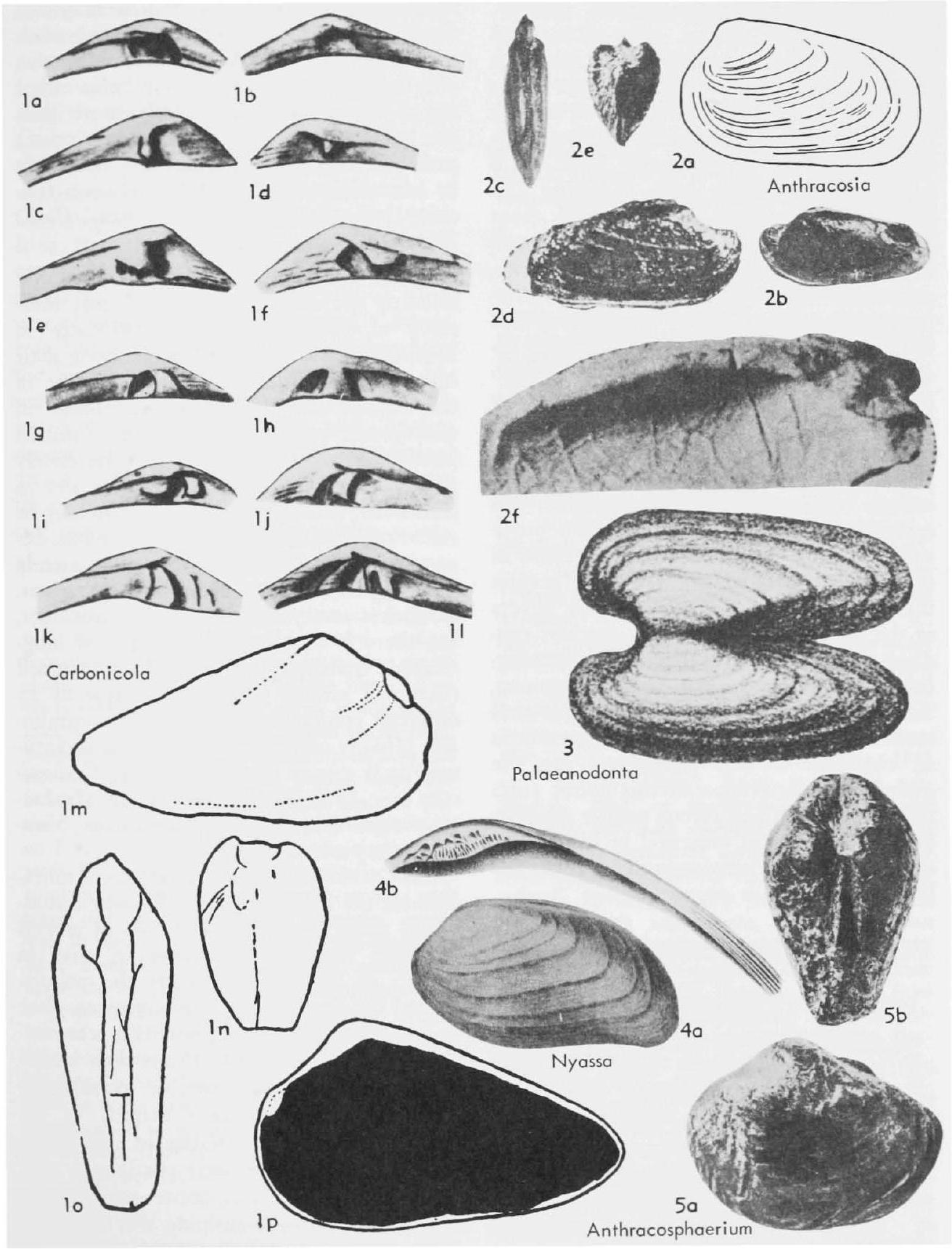 Fig. D10,1a-l. C. sp. aff. C. pseudorobusta (Trueman), Scot., l a-l, hinges, LV's on left and unpaired, X1 (565).-Fig. D10,1m-p. *C. acuta (J. Sowerby), Eng., 1 m- o, lectotype (a mold, RV lat., both valves ant., dorsal), X1, 1 p, same, LV, with shell restored, X1 (915a).
Synonyms
Geographic Distribution
W.Eu.-USSR(Donetz)
Age Range
Beginning Stage in Treatise Usage:
Carb.(especially U.Carb.Namur.-Westphal. A)
Beginning International Stage:
Serpukhovian
Fraction Up In Beginning Stage:
0
Beginning Date:
330.34
Ending Stage in Treatise Usage:
Carb.(especially U.Carb.Namur.-Westphal. A)
Ending International Stage:
Moscovian
Fraction Up In Ending Stage:
25
Ending Date:
313.12
Description
Like Anthracosia, but umbones erect, in most shells unequal in height, and umbonal growth lines usually not tilted, Hinge line curved, rarely straight behind umbo, hinge plates deep, forming continuous arc without marked division into anterior and posterior portions as in Anthracosia, 1 subumbonal tooth on one or both valves, or 2 in some, rarely more, or edentulous, Outline of internal mold in dorsal plan forming double wedge, beaks of mold prominent and divergent, its median dorsal ridge weak, anterior lobe not compressed and demarcated from rest of mold as in Anthracosia
References
Museum or Author Information
Classification
Phylum:
Mollusca
Class:
Bivalvia
Subclass:
Palaeoheterodonta
Order:
Unionoida (Freshwater mussels and relatives)
Superfamily:
Anthracosiacea
Family:
Anthracosiidae
Formal Genus Name and Reference:
Carbonicola M'COV, 1855
Type Species:
Unio acutus J. Sowerby, 1813, SD Davies & TRUEMAN, 1927
Images
(Click to enlarge in a new window)
Fig. D10,1a-l. C. sp. aff. C. pseudorobusta (Trueman), Scot., l a-l, hinges, LV's on left and unpaired, X1 (565).-Fig. D10,1m-p. *C. acuta (J. Sowerby), Eng., 1 m- o, lectotype (a mold, RV lat., both valves ant., dorsal), X1, 1 p, same, LV, with shell restored, X1 (915a).
Synonyms
Geographic Distribution
W.Eu.-USSR(Donetz)
Age Range
Beginning Stage in Treatise Usage:
Carb.(especially U.Carb.Namur.-Westphal. A)
Beginning International Stage:
Serpukhovian
Fraction Up In Beginning Stage:
0
Beginning Date:
330.34
Ending Stage in Treatise Usage:
Carb.(especially U.Carb.Namur.-Westphal. A)
Ending International Stage:
Moscovian
Fraction Up In Ending Stage:
25
Ending Date:
313.12
Description
Like Anthracosia, but umbones erect, in most shells unequal in height, and umbonal growth lines usually not tilted, Hinge line curved, rarely straight behind umbo, hinge plates deep, forming continuous arc without marked division into anterior and posterior portions as in Anthracosia, 1 subumbonal tooth on one or both valves, or 2 in some, rarely more, or edentulous, Outline of internal mold in dorsal plan forming double wedge, beaks of mold prominent and divergent, its median dorsal ridge weak, anterior lobe not compressed and demarcated from rest of mold as in Anthracosia