
Welcome to the Bivalves subsite on Invertebrate Paleontology!
Please enter a genera name to retrieve more information.
Ceratostreon
Classification
Phylum:
Mollusca
Class:
None
Subclass:
Pteriomorphia
Order:
Pterioida
Suborder:
Ostreina (oysters)
Superfamily:
Ostreacea
Family:
Gryphaeidae
Subfamily:
Exogyrinae - TRIBE Exogyrini
Formal Genus Name and Reference:
Ceratostreon BAYLE, 1878, pl. 133-134 explanations
Type Species:
Exogira spinosa Matheron, 1843, p. 192 (=Ostrea matheroniana d'Orbigny, 1848, p. 737, Ceratostreon matheroni Bayle, 1878, pl. 134, fig. 1-2, 10-11), SD DOUVILLÉ, 1879
Images
(Click to enlarge in a new window)
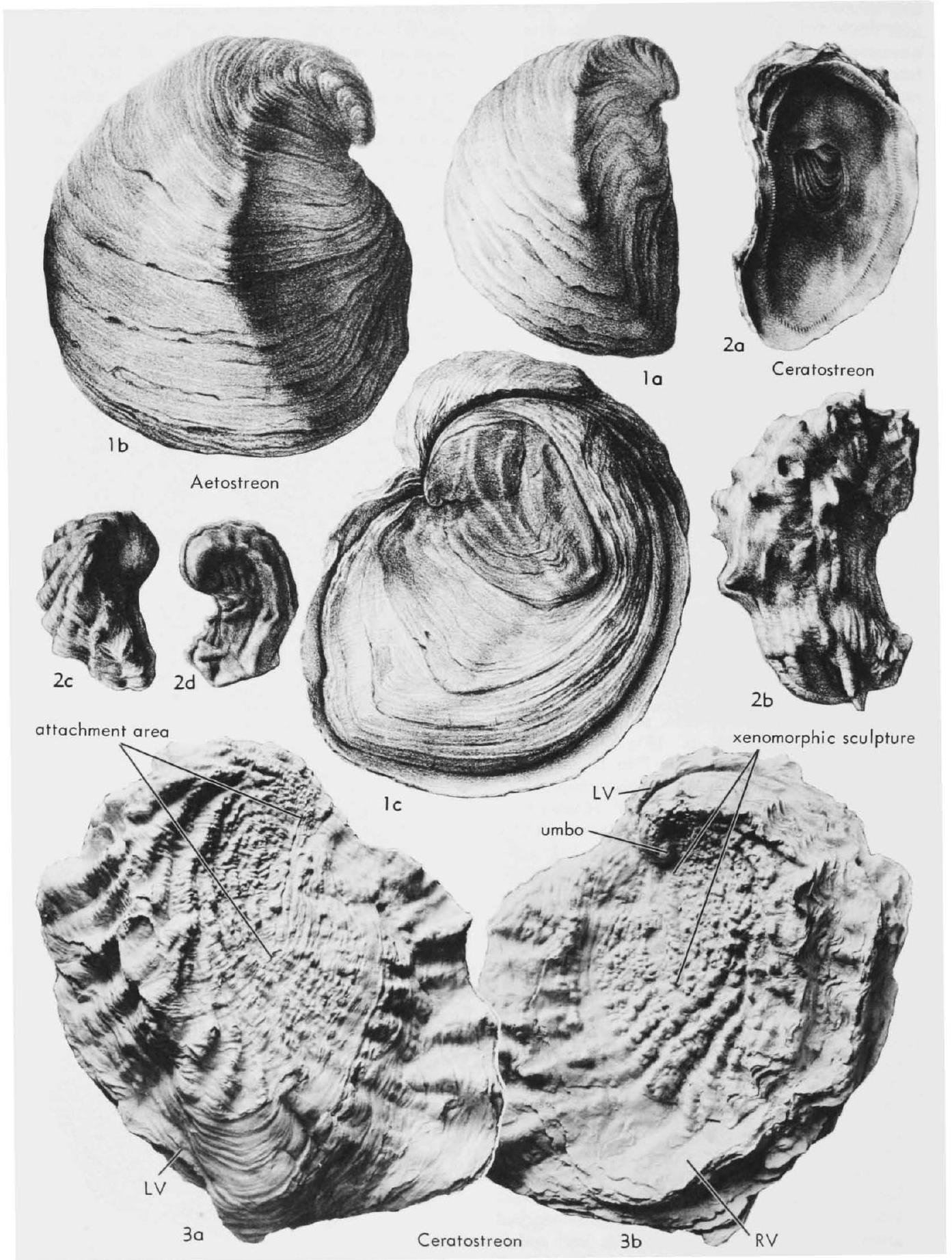 Fig. J92,2. *C. spinosum (Matheron), U.Cret., France (Royan, Département Charente-Inférieure), 2a, b, LV int., ext., × 0.7, 2c, d, shell ext. from LV and RV sides, × 0.7 (Bayle, 1878). -- Fig. J92,3. C. texanum (ROEMER, 1852), mid.Alb.(Up. Walnut Clay), Texas (Coryell Co. near Mound); 3a,b, shell ext. from LV and RV sides, XI (Stenzel, n). [See also Fig. J45.]
Synonyms
Ceratostrea
Geographic Distribution
L. Cret.(Apt.-mid. Alb.), N. Am.(MexicoTexas-Okla.-Kans.)-S. Am.(Colom.); Cret.(Neocom.-Senon.), Eu.-N. Afr
Age Range
Beginning Stage in Treatise Usage:
L. Cret.(Apt.-mid. Alb.), or Cret.(Neocom.-Senon.)
Beginning International Stage:
Aptian
Fraction Up In Beginning Stage:
0
Beginning Date:
121.4
Ending Stage in Treatise Usage:
L. Cret.(Apt.-mid. Alb.), or Cret.(Neocom.-Senon.)
Ending International Stage:
Cenomanian
Fraction Up In Ending Stage:
100
Ending Date:
93.9
Description
Medium-sized (up to 10 cm), outline narrow, elongate and crescentically curved or comma-shaped to ovate with umbonal region forming larger end. Shell inequivalve. Attachment area generally large. Both valves keeled, but merely in sense that each has 2 different slopes which meet along spirally disposed crest that is much obscured by surface sculpture that crosses it, anterior slope narrower, descending steeply to anterior valve margin, posterior slope larger, descending more gently to posterior valve margin, flat or concave on RV, gently convex on LV. Many dichotomous, unequal, rounded costae and equally large and rounded interspaces on both valves, costae of type species short, discontinuous, and rising at their ends into prominent spines, particularly at places where costae cross keel, in other species costae are continuous and less spinous, costae in many consisting of series of contiguous transverse puckers. Chomata slender and well developed, 1-5 mm long, situated along all periphery of the valves. [D'ORBIGNY filed to explain why he changed the species name from spinosa to mathaoniana; possibly he was aware that already an Ostracites spinosus VON SCHlOTHEIM, 1813, p. 73, and an Ostrea spinosa F. A. ROEMER, 1835, p. 58 were available. No proof is found to indicate that these homonyms are congeneric; therefore MATHERON'S name is retained in preference to the others. STENZEL'S (l947, p. 171) conclusion that Ceratostreon must date from DouViLlE, 1879. is no longer correct in view of changes in the zoological Cod< (1964).]
References
Museum or Author Information
Classification
Phylum:
Mollusca
Class:
None
Subclass:
Pteriomorphia
Order:
Pterioida
Suborder:
Ostreina (oysters)
Superfamily:
Ostreacea
Family:
Gryphaeidae
Subfamily:
Exogyrinae - TRIBE Exogyrini
Formal Genus Name and Reference:
Ceratostreon BAYLE, 1878, pl. 133-134 explanations
Type Species:
Exogira spinosa Matheron, 1843, p. 192 (=Ostrea matheroniana d'Orbigny, 1848, p. 737, Ceratostreon matheroni Bayle, 1878, pl. 134, fig. 1-2, 10-11), SD DOUVILLÉ, 1879
Images
(Click to enlarge in a new window)
Fig. J92,2. *C. spinosum (Matheron), U.Cret., France (Royan, Département Charente-Inférieure), 2a, b, LV int., ext., × 0.7, 2c, d, shell ext. from LV and RV sides, × 0.7 (Bayle, 1878). -- Fig. J92,3. C. texanum (ROEMER, 1852), mid.Alb.(Up. Walnut Clay), Texas (Coryell Co. near Mound); 3a,b, shell ext. from LV and RV sides, XI (Stenzel, n). [See also Fig. J45.]
Synonyms
Ceratostrea
Geographic Distribution
L. Cret.(Apt.-mid. Alb.), N. Am.(MexicoTexas-Okla.-Kans.)-S. Am.(Colom.); Cret.(Neocom.-Senon.), Eu.-N. Afr
Age Range
Beginning Stage in Treatise Usage:
L. Cret.(Apt.-mid. Alb.), or Cret.(Neocom.-Senon.)
Beginning International Stage:
Aptian
Fraction Up In Beginning Stage:
0
Beginning Date:
121.4
Ending Stage in Treatise Usage:
L. Cret.(Apt.-mid. Alb.), or Cret.(Neocom.-Senon.)
Ending International Stage:
Cenomanian
Fraction Up In Ending Stage:
100
Ending Date:
93.9
Description
Medium-sized (up to 10 cm), outline narrow, elongate and crescentically curved or comma-shaped to ovate with umbonal region forming larger end. Shell inequivalve. Attachment area generally large. Both valves keeled, but merely in sense that each has 2 different slopes which meet along spirally disposed crest that is much obscured by surface sculpture that crosses it, anterior slope narrower, descending steeply to anterior valve margin, posterior slope larger, descending more gently to posterior valve margin, flat or concave on RV, gently convex on LV. Many dichotomous, unequal, rounded costae and equally large and rounded interspaces on both valves, costae of type species short, discontinuous, and rising at their ends into prominent spines, particularly at places where costae cross keel, in other species costae are continuous and less spinous, costae in many consisting of series of contiguous transverse puckers. Chomata slender and well developed, 1-5 mm long, situated along all periphery of the valves. [D'ORBIGNY filed to explain why he changed the species name from spinosa to mathaoniana; possibly he was aware that already an Ostracites spinosus VON SCHlOTHEIM, 1813, p. 73, and an Ostrea spinosa F. A. ROEMER, 1835, p. 58 were available. No proof is found to indicate that these homonyms are congeneric; therefore MATHERON'S name is retained in preference to the others. STENZEL'S (l947, p. 171) conclusion that Ceratostreon must date from DouViLlE, 1879. is no longer correct in view of changes in the zoological Cod< (1964).]