
Welcome to the Bivalves subsite on Invertebrate Paleontology!
Please enter a genera name to retrieve more information.
Glyptoactis
Classification
Phylum:
Mollusca
Class:
Bivalvia
Subclass:
Heterodonta
Order:
Veneroida
Superfamily:
Carditacea
Family:
Carditidae
Subfamily:
Carditesinae
Formal Genus Name and Reference:
Glyptoactis STEWART, 1930
Type Species:
V enericardia hadra DALL, 1903; OD
Images
(Click to enlarge in a new window)
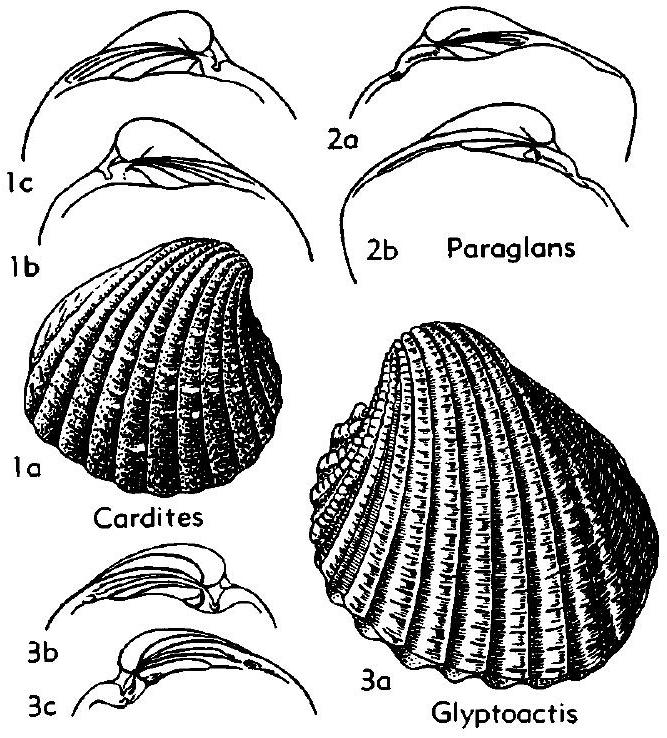 Fig. E56,3. *G. (G.) hadra (Dall), Mio., USA(Fla.), 3a, LV ext., X1, 3 b, c, LV and RV hinges, X1 (229, Chavan, n)
Synonyms
Geographic Distribution
N.Am.-Eu.-Afr.
Age Range
Beginning Stage in Treatise Usage:
U.Cret.(Senon.)
Beginning International Stage:
Coniacian
Fraction Up In Beginning Stage:
0
Beginning Date:
89.39
Ending Stage in Treatise Usage:
Mio.
Ending International Stage:
Messinian
Fraction Up In Ending Stage:
100
Ending Date:
5.34
Description
Short trapezoidal, with high nodulose or echinate ribs; small, irregularly convex lunule extending under and slightly behind beaks. Hinge with very low 2, thin, long 4b, rather indistinct 3a, and strong, oblique 3b; All minute tuberculiform, close to 2, PlI faint.
References
Museum or Author Information
Classification
Phylum:
Mollusca
Class:
Bivalvia
Subclass:
Heterodonta
Order:
Veneroida
Superfamily:
Carditacea
Family:
Carditidae
Subfamily:
Carditesinae
Formal Genus Name and Reference:
Glyptoactis STEWART, 1930
Type Species:
V enericardia hadra DALL, 1903; OD
Images
(Click to enlarge in a new window)
Fig. E56,3. *G. (G.) hadra (Dall), Mio., USA(Fla.), 3a, LV ext., X1, 3 b, c, LV and RV hinges, X1 (229, Chavan, n)
Synonyms
Geographic Distribution
N.Am.-Eu.-Afr.
Age Range
Beginning Stage in Treatise Usage:
U.Cret.(Senon.)
Beginning International Stage:
Coniacian
Fraction Up In Beginning Stage:
0
Beginning Date:
89.39
Ending Stage in Treatise Usage:
Mio.
Ending International Stage:
Messinian
Fraction Up In Ending Stage:
100
Ending Date:
5.34
Description
Short trapezoidal, with high nodulose or echinate ribs; small, irregularly convex lunule extending under and slightly behind beaks. Hinge with very low 2, thin, long 4b, rather indistinct 3a, and strong, oblique 3b; All minute tuberculiform, close to 2, PlI faint.