
Welcome to the Bivalves subsite on Invertebrate Paleontology!
Please enter a genera name to retrieve more information.

Gresslya
Classification
Phylum:
Mollusca
Class:
Bivalvia
Subclass:
Anomalodesmata
Order:
Pholadomyoida
Superfamily:
Pholadomyacea
Family:
Ceratomyidae
Formal Genus Name and Reference:
Gresslya AGASSIZ, 1843, p. 202
Type Species:
Lutraria gregaria Zieten, 1833, p. 85, SD HERRMANNSEN, 1847, p. 490, as "Lutraria gregaria Goldfuss"
Images
(Click to enlarge in a new window)
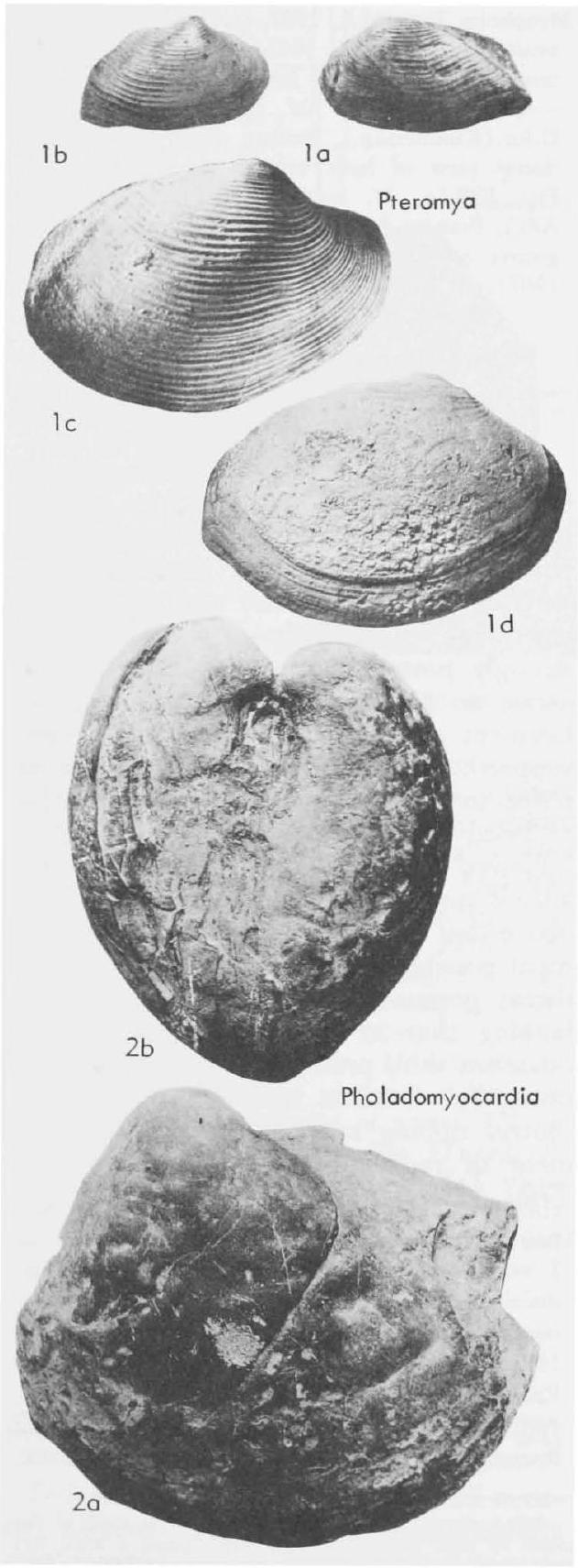 Fig. F18,2a,b. G. peregrina (PHILLIPS), U. Jue.(Oxford), Eng.; 2a,b, LV into mold showing pallial sinus, dorsal view of both valves showing slit extending back from beak in RV, X1.3 (Cox, n). --Fig. F18,2e. *G. gregaria (ZIETEN), M. Jur.(Bajoc), Gee.; LV ext., Xl (Schmidtill, 1926). --Fig. F18,2d. G. abdueta (PHILLIPS), M.Jur. (Bajoc.), Eng.; transv. sec. through hinge region short distance behind beaks, LV and RV as ori- ented, edge marked "X" giving rise to the slit on internal molds; X3.3 (Cox, n)
Synonyms
Gresslyia, Greslya, Gressluya
Geographic Distribution
cosmop.
Age Range
Beginning Stage in Treatise Usage:
L.Jur
Beginning International Stage:
Hettangian
Fraction Up In Beginning Stage:
0
Beginning Date:
201.36
Ending Stage in Treatise Usage:
U.Jur.
Ending International Stage:
Tithonian
Fraction Up In Ending Stage:
100
Ending Date:
143.1
Description
Ovate, usually with cunei- form tendancy, moderately elongate, umbones not prominent, that of RV slightly higher than LV; valves with narrow posterior gape; hinge structure as defined for family, slit extending back from beak on internal molds of RV even better defined and more constant than in Ceratomya; both valves in some specimens with a weak tooth-like callosity of the antero-dorsal margin near the beak; pallial line with a deep sinus; surface without conspicuous ornament but bearing very fine pustules or puncta radially aligned.
References
Museum or Author Information
Classification
Phylum:
Mollusca
Class:
Bivalvia
Subclass:
Anomalodesmata
Order:
Pholadomyoida
Superfamily:
Pholadomyacea
Family:
Ceratomyidae
Formal Genus Name and Reference:
Gresslya AGASSIZ, 1843, p. 202
Type Species:
Lutraria gregaria Zieten, 1833, p. 85, SD HERRMANNSEN, 1847, p. 490, as "Lutraria gregaria Goldfuss"
Images
(Click to enlarge in a new window)
Fig. F18,2a,b. G. peregrina (PHILLIPS), U. Jue.(Oxford), Eng.; 2a,b, LV into mold showing pallial sinus, dorsal view of both valves showing slit extending back from beak in RV, X1.3 (Cox, n). --Fig. F18,2e. *G. gregaria (ZIETEN), M. Jur.(Bajoc), Gee.; LV ext., Xl (Schmidtill, 1926). --Fig. F18,2d. G. abdueta (PHILLIPS), M.Jur. (Bajoc.), Eng.; transv. sec. through hinge region short distance behind beaks, LV and RV as ori- ented, edge marked "X" giving rise to the slit on internal molds; X3.3 (Cox, n)
Synonyms
Gresslyia, Greslya, Gressluya
Geographic Distribution
cosmop.
Age Range
Beginning Stage in Treatise Usage:
L.Jur
Beginning International Stage:
Hettangian
Fraction Up In Beginning Stage:
0
Beginning Date:
201.36
Ending Stage in Treatise Usage:
U.Jur.
Ending International Stage:
Tithonian
Fraction Up In Ending Stage:
100
Ending Date:
143.1
Description
Ovate, usually with cunei- form tendancy, moderately elongate, umbones not prominent, that of RV slightly higher than LV; valves with narrow posterior gape; hinge structure as defined for family, slit extending back from beak on internal molds of RV even better defined and more constant than in Ceratomya; both valves in some specimens with a weak tooth-like callosity of the antero-dorsal margin near the beak; pallial line with a deep sinus; surface without conspicuous ornament but bearing very fine pustules or puncta radially aligned.