
Welcome to the Bivalves subsite on Invertebrate Paleontology!
Please enter a genera name to retrieve more information.

Gryphaea
Classification
Phylum:
Mollusca
Class:
None
Subclass:
Pteriomorphia
Order:
Pterioida
Suborder:
Ostreina (oysters)
Superfamily:
Ostreacea
Family:
Gryphaeidae
Subfamily:
Gryphaeinae
Formal Genus Name and Reference:
Gryphaea LAMARCK, 1801, p. 398 [Official List, ICZN Opin. 338] [non Gryphaea FISCHER, 1886, p. 927 (=Crassostrea SACCO, 1897)]
Type Species:
G. armata; SD ICZN, Opin. 338
Images
(Click to enlarge in a new window)
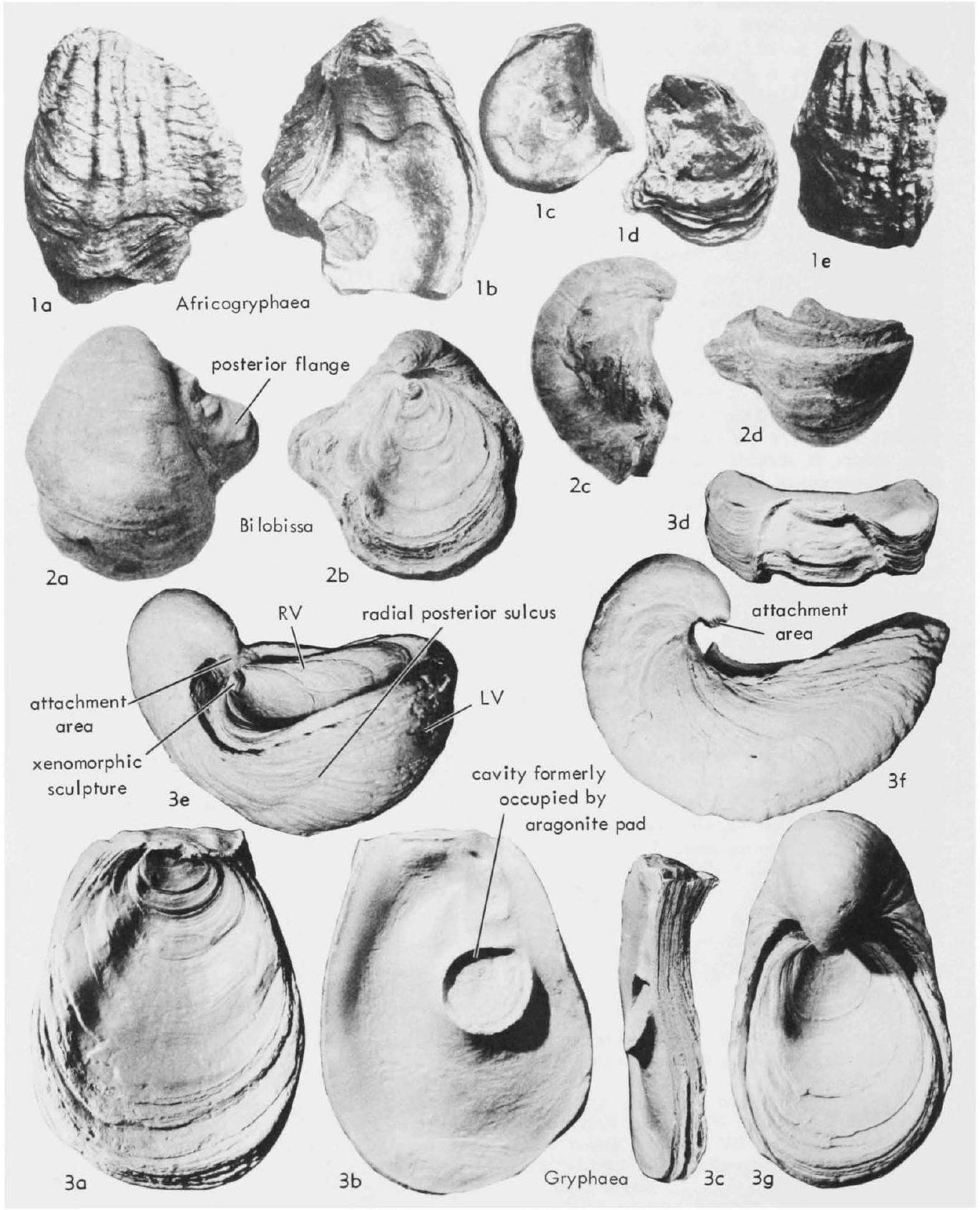 Fig. J74,3. *G. (G.) arcuata Lamarck, L. Jur.(Lias.), Eng., 3a-d, RV, various views, aragonite of adductor muscle pad leached, X1, 3 e-g, entire shell, various views, X1 (Stenzel, n)."
Synonyms
Gryphoea, Gryphaeigenus, Gryphites, Griphea, Gryphea, Liogryphaea, Gryphaae, Liogryphea, Ghyphaea, Lyogryphaea, Jurogryphaea, Incurva, Gryphaca, Rygepha, Liogriphaea, Liographaea, Liogryphaea, Gruphea, Griphae, Cryphaea
Geographic Distribution
U.Trias., Boreal Prov.(B.C.-Can.Arctic- Bear I.-Far NE.Sib.)-USA(Nev.); L.fur.{Hettang.)-U.Jur .( Kimmeridg.), worldwide.
Age Range
Beginning Stage in Treatise Usage:
U.Trias.
Beginning International Stage:
Carnian
Fraction Up In Beginning Stage:
0
Beginning Date:
237
Ending Stage in Treatise Usage:
U.Jur (Kimmidg.)
Ending International Stage:
Kimmeridgian
Fraction Up In Ending Stage:
100
Ending Date:
149.24
Description
Shell medium- sized to large (up to 16 cm. long and 14 cm. high), LV ranging from high and narrow (H (height] about 178 percent of L (length]) in some species to orbicular to horizontal-oval (H about 70 percent of L) to bilobate-oval (H about 80 percent of L) to bilobate-triangular in others, orthocline to very slightly opisthocline, convex and capacious, ranging from highly convex to broadly convex in horizontal cross section; not compressed and devoid of median radial keel. LV with radial posterior sulcus ranging from evanescent to deeply sunken, posterior flange poorly or well set off from main body of valve (bilobate forms), and beak small, pointed, opis- thogyral to nearly orthogyral, highly inrolled with tiny attachment scar in some species to less in- rolled and with large attachment scar in others; LV smooth or with low smooth irregular concen- tric growth welts or with low smooth regularly spaced concentric undulations, mostly with ap- pressed or rarely nonappressed growth squamae, either devoid of radial ribs or furnished with them (Fig. ]74). RV concave, vertical-oval to spatulate, orbicular, horizontal-elliptic, or bilobate, truncated by hinge, without ribs or having few narrow radial gashes or threads, and having ap- pressed or nonappressed growth squamae. Resili- fer ranging in size from as long as to 5 times length of each bourrelet of ligament, excavate in LV and flat to very slightly excavate in RV. Umbonal cavity beneath hinge plate on inside of LV largely filled in by thickened shell (Fig. ]73, 2a); commissural shelf well developed but without chomata. Adductor muscle imprint orbicular to oval, with dorsal margin clearly convex and ven- tral edge projecting obliquely upward into shell cavity.
References
Lamarck, J. B. A. P. M. de, 1801, Système des animaux sans vertébres, ou tableau général des classes, des ordres et des genres de ces animaux: [edit. 1], viii+ 432 p., Deterville (Paris) (Jan.).
Museum or Author Information
Classification
Phylum:
Mollusca
Class:
None
Subclass:
Pteriomorphia
Order:
Pterioida
Suborder:
Ostreina (oysters)
Superfamily:
Ostreacea
Family:
Gryphaeidae
Subfamily:
Gryphaeinae
Formal Genus Name and Reference:
Gryphaea LAMARCK, 1801, p. 398 [Official List, ICZN Opin. 338] [non Gryphaea FISCHER, 1886, p. 927 (=Crassostrea SACCO, 1897)]
Type Species:
G. armata; SD ICZN, Opin. 338
Images
(Click to enlarge in a new window)
Fig. J74,3. *G. (G.) arcuata Lamarck, L. Jur.(Lias.), Eng., 3a-d, RV, various views, aragonite of adductor muscle pad leached, X1, 3 e-g, entire shell, various views, X1 (Stenzel, n)."
Synonyms
Gryphoea, Gryphaeigenus, Gryphites, Griphea, Gryphea, Liogryphaea, Gryphaae, Liogryphea, Ghyphaea, Lyogryphaea, Jurogryphaea, Incurva, Gryphaca, Rygepha, Liogriphaea, Liographaea, Liogryphaea, Gruphea, Griphae, Cryphaea
Geographic Distribution
U.Trias., Boreal Prov.(B.C.-Can.Arctic- Bear I.-Far NE.Sib.)-USA(Nev.); L.fur.{Hettang.)-U.Jur .( Kimmeridg.), worldwide.
Age Range
Beginning Stage in Treatise Usage:
U.Trias.
Beginning International Stage:
Carnian
Fraction Up In Beginning Stage:
0
Beginning Date:
237
Ending Stage in Treatise Usage:
U.Jur (Kimmidg.)
Ending International Stage:
Kimmeridgian
Fraction Up In Ending Stage:
100
Ending Date:
149.24
Description
Shell medium- sized to large (up to 16 cm. long and 14 cm. high), LV ranging from high and narrow (H (height] about 178 percent of L (length]) in some species to orbicular to horizontal-oval (H about 70 percent of L) to bilobate-oval (H about 80 percent of L) to bilobate-triangular in others, orthocline to very slightly opisthocline, convex and capacious, ranging from highly convex to broadly convex in horizontal cross section; not compressed and devoid of median radial keel. LV with radial posterior sulcus ranging from evanescent to deeply sunken, posterior flange poorly or well set off from main body of valve (bilobate forms), and beak small, pointed, opis- thogyral to nearly orthogyral, highly inrolled with tiny attachment scar in some species to less in- rolled and with large attachment scar in others; LV smooth or with low smooth irregular concen- tric growth welts or with low smooth regularly spaced concentric undulations, mostly with ap- pressed or rarely nonappressed growth squamae, either devoid of radial ribs or furnished with them (Fig. ]74). RV concave, vertical-oval to spatulate, orbicular, horizontal-elliptic, or bilobate, truncated by hinge, without ribs or having few narrow radial gashes or threads, and having ap- pressed or nonappressed growth squamae. Resili- fer ranging in size from as long as to 5 times length of each bourrelet of ligament, excavate in LV and flat to very slightly excavate in RV. Umbonal cavity beneath hinge plate on inside of LV largely filled in by thickened shell (Fig. ]73, 2a); commissural shelf well developed but without chomata. Adductor muscle imprint orbicular to oval, with dorsal margin clearly convex and ven- tral edge projecting obliquely upward into shell cavity.
References
Lamarck, J. B. A. P. M. de, 1801, Système des animaux sans vertébres, ou tableau général des classes, des ordres et des genres de ces animaux: [edit. 1], viii+ 432 p., Deterville (Paris) (Jan.).