
Welcome to the Bivalves subsite on Invertebrate Paleontology!
Please enter a genera name to retrieve more information.

Orthonota
Classification
Phylum:
Mollusca
Class:
Bivalvia
Subclass:
Anomalodesmata
Order:
Pholadomyoida
Superfamily:
Pholadomyacea
Family:
Orthonotidae
Formal Genus Name and Reference:
Orthonota CONRAD, 1841, p. 50
Type Species:
O. undulata
Images
(Click to enlarge in a new window)
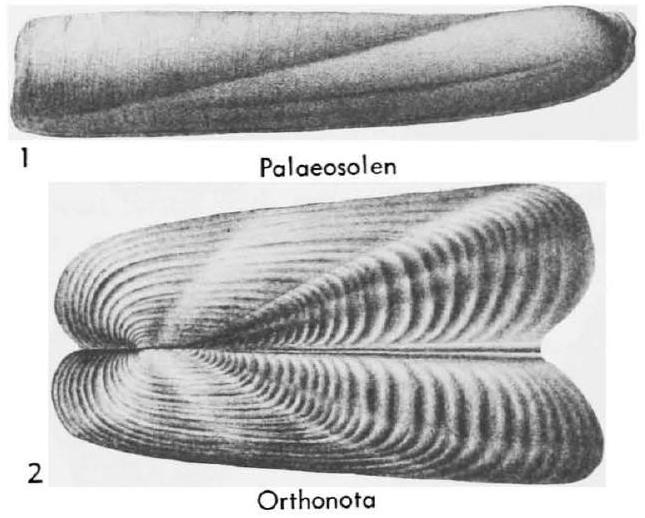 Fig. F2,2. *O. undulata, M.Dev.(Hamilton.), USA(N.Y.), bivalve specimen, composite mold, X1 (379)
Synonyms
Geographic Distribution
N.Am.-Eu.
Age Range
Beginning Stage in Treatise Usage:
M.Ord.(Llandeil.-Caradoc.)
Beginning International Stage:
Darriwilian
Fraction Up In Beginning Stage:
56.9
Beginning Date:
463.02
Ending Stage in Treatise Usage:
M.Dev.(Hamilton.)
Ending International Stage:
Givetian
Fraction Up In Ending Stage:
100
Ending Date:
378.9
Description
Very elongate, more than 4 times longer than height, gaping slightly posteriorly, beaks about 0.2 length behind front margin, anterior surface with concentric growth lines and, on postumbonal slope, strong concentric undulations and radial folds, ligament enclosed in linear fold on cardinal margin, edentulous
References
Museum or Author Information
Classification
Phylum:
Mollusca
Class:
Bivalvia
Subclass:
Anomalodesmata
Order:
Pholadomyoida
Superfamily:
Pholadomyacea
Family:
Orthonotidae
Formal Genus Name and Reference:
Orthonota CONRAD, 1841, p. 50
Type Species:
O. undulata
Images
(Click to enlarge in a new window)
Fig. F2,2. *O. undulata, M.Dev.(Hamilton.), USA(N.Y.), bivalve specimen, composite mold, X1 (379)
Synonyms
Geographic Distribution
N.Am.-Eu.
Age Range
Beginning Stage in Treatise Usage:
M.Ord.(Llandeil.-Caradoc.)
Beginning International Stage:
Darriwilian
Fraction Up In Beginning Stage:
56.9
Beginning Date:
463.02
Ending Stage in Treatise Usage:
M.Dev.(Hamilton.)
Ending International Stage:
Givetian
Fraction Up In Ending Stage:
100
Ending Date:
378.9
Description
Very elongate, more than 4 times longer than height, gaping slightly posteriorly, beaks about 0.2 length behind front margin, anterior surface with concentric growth lines and, on postumbonal slope, strong concentric undulations and radial folds, ligament enclosed in linear fold on cardinal margin, edentulous