
Welcome to the Bivalves subsite on Invertebrate Paleontology!
Please enter a genera name to retrieve more information.
Pycnodonte
Classification
Phylum:
Mollusca
Class:
None
Subclass:
Pteriomorphia
Order:
Pterioida
Suborder:
Ostreina (oysters)
Superfamily:
Ostreacea
Family:
Gryphaeidae
Subfamily:
Pycnodonteinae
Formal Genus Name and Reference:
Pycnodonte Fischer de Waldheim, 1835, p. 118119
Type Species:
P. radiata, OD
Images
(Click to enlarge in a new window)
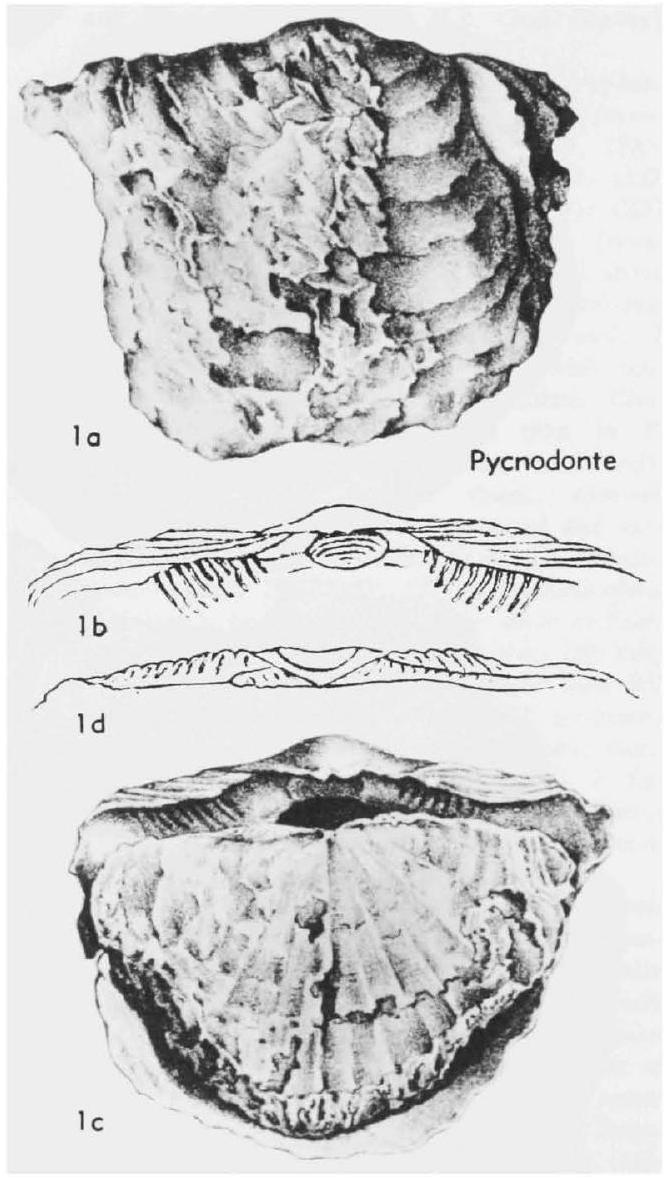
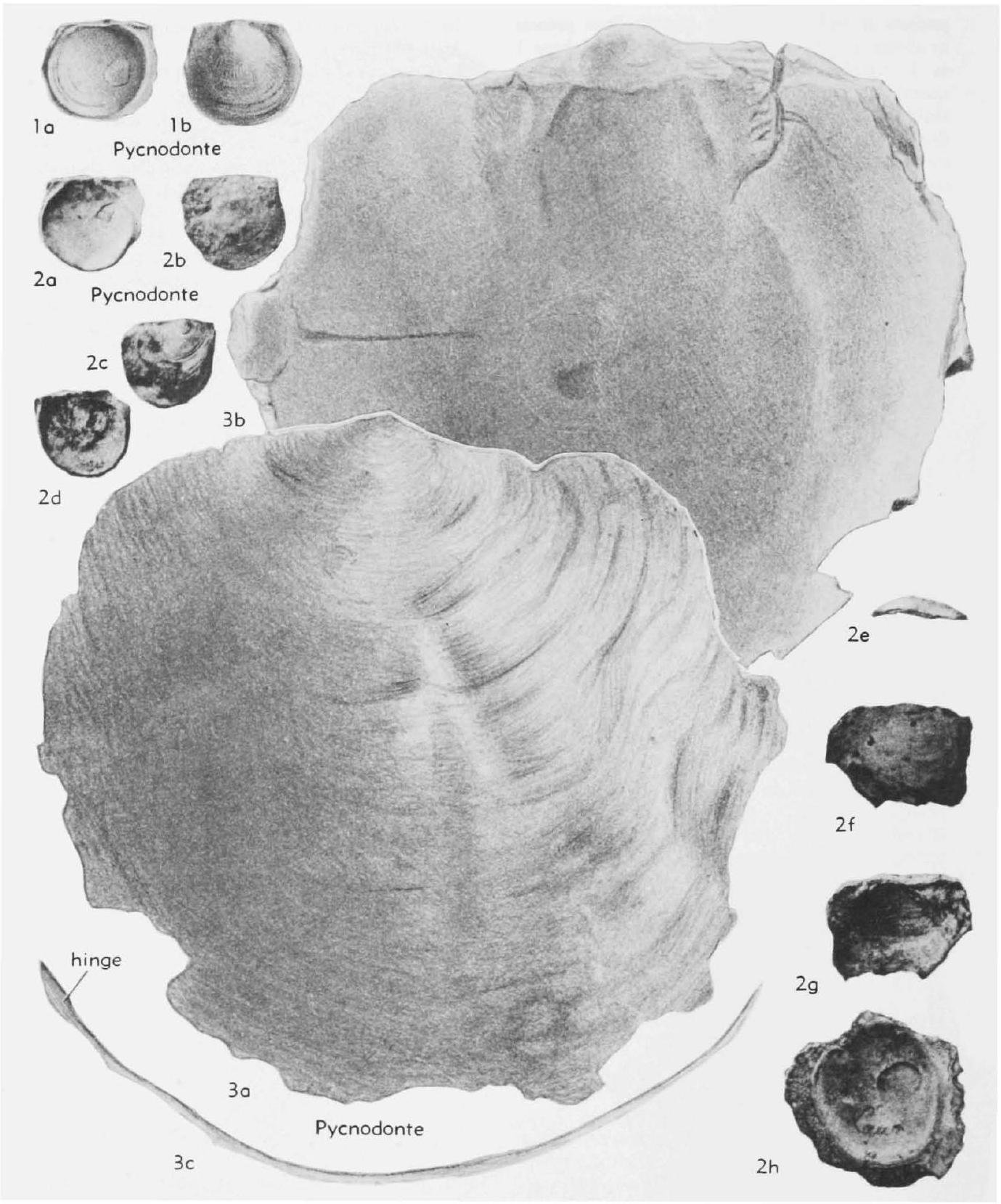 Fig. J80,1. *P. (P.) radiata Fischer de WaldhE1m, 1835, U.Cret., Crimea, 1 a, LV ext., 16 , LV umbo and hinge, 1 c, both valves seen from right side, 1 d, RV umbo and hinge, all X0.5 (Fischer de WaldhE1m, 1835).-Fig. J81,1,2. P. (P.) gigantica (Solander in Brander, 1766) (="Ostrea (Gigantostrea)" Sacco, 1897), Eoc.(Barton. ), Barton Cliff, Eng., 1 a, b, LV ext. and int. views, 1 c, RV int., 2 a, b, both valves, ext., all X0.5 photographs courtesy of +L. R. Cox, British Museum (Nat. History). -Fig. J82,1,2. P. (P.) subhippodium (D'Archiac, 1850) (="Ostrea(Biauris)" Cossmann, 1922), Eoc.(Barton. ), Trabay, France (la,b) and Biarritz and vicinity, SW.France ( 2 a-h), 1 a, b, RV int., ext., X1 (D'Archiac, 1850), 2 a, b, e, RV int., ext., edge view, 2 c, d, RV int., ext., 2 f, g, LV ext., int., 2 h, RV int., all X1 (Cossmann, 1922).-Fig. J82,3. P. (P.) sinzowi (Nechaev, 1897) (="Gryphaea (Gryphaea) section Circogryphaea" Vyalov, 1936), Paleoc. below Kamyshin on Volga R., USSR, 3a-c, LV ext., int., section along mid-axis, X1 (Nechaev, 1897).
Synonyms
Pycnodonta, Pycnoduntam, Pycnoduntam Pycnondota, Cretagryphaea, Pychnodonta
Geographic Distribution
Cret.-Mio., cosmop.
Age Range
Beginning Stage in Treatise Usage:
Cret..
Beginning International Stage:
Berriasian
Fraction Up In Beginning Stage:
0
Beginning Date:
143.1
Ending Stage in Treatise Usage:
Mio.
Ending International Stage:
Messinian
Fraction Up In Ending Stage:
100
Ending Date:
5.34
Description
Small to large (up to 16 em. long). LV mostly highly convex; attachment area small to quite large; LV umbo incurved, either rises barely above hinge line or well above it, species with low umbo subcircular or semicircular in outline, some have long straight dorsal margins continuing in auricles (as in type species), species with prominent raised umbo vertical-oval or prosocline oblique-oval to horizontal-oval in outline and lack auricles, species with either of 2 last-mentioned outlines have concave geniculate posterodorsal margins. Commissural shelf prominent; chomata either long and straight (as in Crenostrea) or short to long (up to 13 mm.) and arborescent and vermiculate. Radial posterior sulcus ranges from absent to broad and shallow or broad and deep. Growth squamae nonappressed very closely appressed. Radial ribs on LV' may be absent, gently undulatory and short in some species, or small irregular unequal round-topped and well defined (as in Costeina). Concentric puckers or welts parallel to growth lines present or absent on LV. A few Paleogene species have 1 to 3 sharply raised hyote spines on otherwise smooth LV. RV flat to concave, commonly carries sharp radial gashes. [Many authors have assumed that P. (Pyenodonte) radiata (U.Cret., Crimea) is the same species as P. (Phygraea) vesieularis (LAMARCK) (l806a, p. 160) from the Chalk (Campan.) at Meudon, near Paris, France. In outline, shape, and sculpture they are so dissimilar that this conclusion seems to be erroneous.]
References
Museum or Author Information
Classification
Phylum:
Mollusca
Class:
None
Subclass:
Pteriomorphia
Order:
Pterioida
Suborder:
Ostreina (oysters)
Superfamily:
Ostreacea
Family:
Gryphaeidae
Subfamily:
Pycnodonteinae
Formal Genus Name and Reference:
Pycnodonte Fischer de Waldheim, 1835, p. 118119
Type Species:
P. radiata, OD
Images
(Click to enlarge in a new window)
Fig. J80,1. *P. (P.) radiata Fischer de WaldhE1m, 1835, U.Cret., Crimea, 1 a, LV ext., 16 , LV umbo and hinge, 1 c, both valves seen from right side, 1 d, RV umbo and hinge, all X0.5 (Fischer de WaldhE1m, 1835).-Fig. J81,1,2. P. (P.) gigantica (Solander in Brander, 1766) (="Ostrea (Gigantostrea)" Sacco, 1897), Eoc.(Barton. ), Barton Cliff, Eng., 1 a, b, LV ext. and int. views, 1 c, RV int., 2 a, b, both valves, ext., all X0.5 photographs courtesy of +L. R. Cox, British Museum (Nat. History). -Fig. J82,1,2. P. (P.) subhippodium (D'Archiac, 1850) (="Ostrea(Biauris)" Cossmann, 1922), Eoc.(Barton. ), Trabay, France (la,b) and Biarritz and vicinity, SW.France ( 2 a-h), 1 a, b, RV int., ext., X1 (D'Archiac, 1850), 2 a, b, e, RV int., ext., edge view, 2 c, d, RV int., ext., 2 f, g, LV ext., int., 2 h, RV int., all X1 (Cossmann, 1922).-Fig. J82,3. P. (P.) sinzowi (Nechaev, 1897) (="Gryphaea (Gryphaea) section Circogryphaea" Vyalov, 1936), Paleoc. below Kamyshin on Volga R., USSR, 3a-c, LV ext., int., section along mid-axis, X1 (Nechaev, 1897).
Synonyms
Pycnodonta, Pycnoduntam, Pycnoduntam Pycnondota, Cretagryphaea, Pychnodonta
Geographic Distribution
Cret.-Mio., cosmop.
Age Range
Beginning Stage in Treatise Usage:
Cret..
Beginning International Stage:
Berriasian
Fraction Up In Beginning Stage:
0
Beginning Date:
143.1
Ending Stage in Treatise Usage:
Mio.
Ending International Stage:
Messinian
Fraction Up In Ending Stage:
100
Ending Date:
5.34
Description
Small to large (up to 16 em. long). LV mostly highly convex; attachment area small to quite large; LV umbo incurved, either rises barely above hinge line or well above it, species with low umbo subcircular or semicircular in outline, some have long straight dorsal margins continuing in auricles (as in type species), species with prominent raised umbo vertical-oval or prosocline oblique-oval to horizontal-oval in outline and lack auricles, species with either of 2 last-mentioned outlines have concave geniculate posterodorsal margins. Commissural shelf prominent; chomata either long and straight (as in Crenostrea) or short to long (up to 13 mm.) and arborescent and vermiculate. Radial posterior sulcus ranges from absent to broad and shallow or broad and deep. Growth squamae nonappressed very closely appressed. Radial ribs on LV' may be absent, gently undulatory and short in some species, or small irregular unequal round-topped and well defined (as in Costeina). Concentric puckers or welts parallel to growth lines present or absent on LV. A few Paleogene species have 1 to 3 sharply raised hyote spines on otherwise smooth LV. RV flat to concave, commonly carries sharp radial gashes. [Many authors have assumed that P. (Pyenodonte) radiata (U.Cret., Crimea) is the same species as P. (Phygraea) vesieularis (LAMARCK) (l806a, p. 160) from the Chalk (Campan.) at Meudon, near Paris, France. In outline, shape, and sculpture they are so dissimilar that this conclusion seems to be erroneous.]